Access rules, entity by entity
Who can create, read, update and delete every kind of record, checked against who should.
An entity with no access rules is open to everyone, even people who never signed in. I review your Base44 app's row-level security, backend functions and secrets, then test it the way someone trying to get in would.
I review your Base44 app's access rules, backend functions and secrets, then test it like someone trying to get in. You get a plain-English report and the fixes.
Who can create, read, update and delete every kind of record, checked against who should.
I try to read other people's data, call functions while signed out and poke the edges, using test accounts.
Does every function check who is calling it? Is the service role used only where it has to be?
Nothing sensitive in the frontend, nothing hard-coded, everything in secrets where it belongs.
Ranked by what would hurt most, in plain English, with fixes I can make or prompts you can run yourself.
Five steps, in this order. You see progress at every one of them.
Step 01
Every entity, every role and who should be able to see what.
Step 02
As a stranger, as a normal user and as an admin, with test accounts.
Step 03
Findings ranked by impact, each with a clear fix.
Step 04
I make the changes, or hand you paste-ready prompts if you'd rather do it yourself.
Step 05
Re-test the fixes and run the security scan one more time.
What people said
Read every reviewAJ is the real deal, from Front End UI, Pen Testing, Complex API integrations.
5.0
from 9 reviews on Base44
What I've built
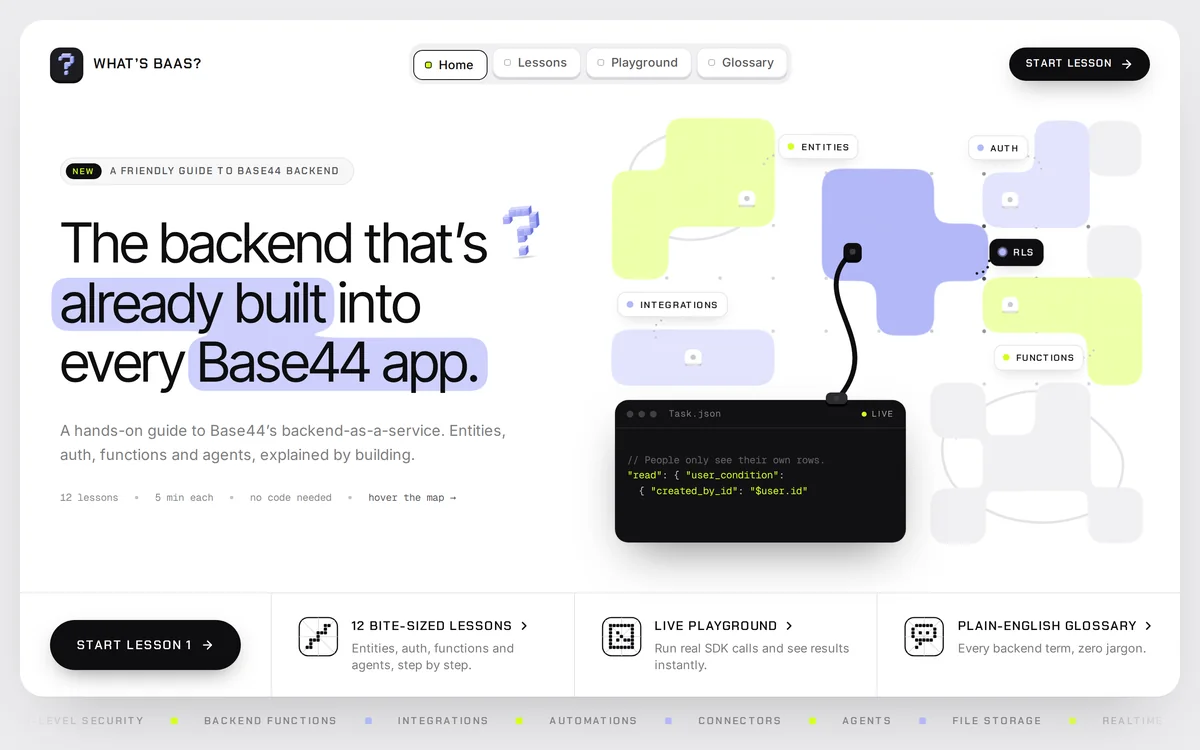
Lesson 7 of my free course teaches row-level security with a wall of parcel lockers.
Read the case studySomething else on your mind? Ask me. I answer everything myself.
Ask a questionThe platform handles a lot for you, like encryption and platform-level protection. But Base44's own docs say you're responsible for your app's security settings. Access rules are yours to get right, and an entity without them is open to everyone.
Testing doesn't need to change anything. I use test accounts and read what's there. Fixes only happen after you've seen the report and said yes.
No, and be wary of anyone who says they can. A review catches the common, costly mistakes, like open entities, unchecked functions and exposed keys. Keep running the security scan whenever you add entities or change rules.
Yes, and you should. Run Base44's security scan from the dashboard, then read my glossary entry on row-level security. If it all makes sense, you might not need me.
Full-stack Base44 apps, built properly from the data up.
Stripe, Resend and third-party APIs, wired in and working.
Interfaces that look designed, not generated.
Send me the app and tell me what it holds. I will tell you where to start.


